The outer space not only leave us mysteries about millions possibility of other living things, but also give us super huge artworks those aged are millions of years. These artworks of course cannot be seen with naked eyes, but our human technology such us Hubble Space Telescope and Spitzer Space telescope have given us the chance to enjoy these remarkable arts.
The Sombrero galaxy is located some 28 million light-years away. Viewed from Earth, it is just six degrees south of its equatorial plane. Spitzer detected infrared emission not only from the ring, but from the center of the galaxy too, where there is a huge black hole, believed to be a billion times more massive than our Sun.
It is called the Sombrero galaxy because of in visible light, it resembles the broad-brimmed Mexican hat. However, in Spitzer's striking infrared view, the galaxy looks more like a "bull's eye."
 |
| The Sombrero Galaxy |
Carina Nebula
The nebula contains at least a dozen brilliant stars that are 50 to 100 times the mass of our Sun. Like cracking open a watermelon and finding its seeds, the infrared telescope "busted open" this murky cloud to reveal star embryos tucked inside finger-like pillars of thick dust. The top of a three-light-year tall pillar of cool hydrogen is being worn away by the radiation of nearby stars, while stars within the pillar unleash jets of gas that stream from the peaks.
 |
| Carina Nebula |
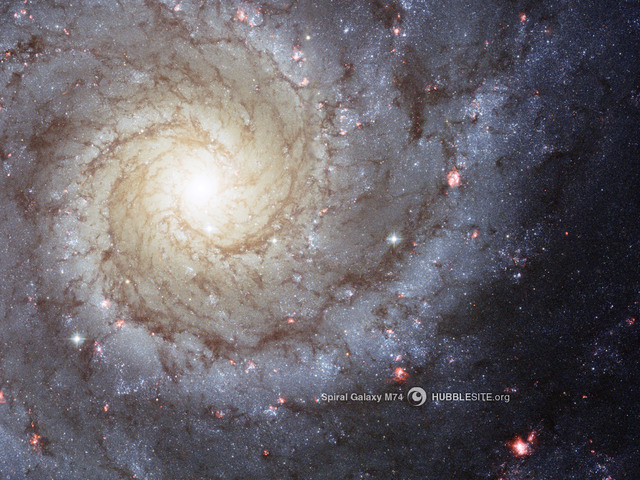
Messier 74
Bright knots of glowing gas light up the arms of spiral galaxy M74, indicating a rich environment of star formation. Messier 74, also called NGC 628, is slightly smaller than our Milky Way.
 |
| M74 Spiral |
The Crab Nebula
The Crab Nebula is a supernova remnant, all that remains of a tremendous stellar explosion. Observers in China and Japan
 |
| Crab Nebula |
Helix Nebula
This eye pupils like nebula is called The Helix Nebula. This detailed picture of the Helix Nebula shows a fine web of filaments, like the spokes of a bicycle, embedded in the colorful red and blue gas ring around this dying star. The Helix Nebula is one of the nearest planetary nebulae to Earth, only 650 light years away
 |
| Helix Nebula |
The Cat's Eye Nebula
Intricate structures of concentric gas shells, jets of high-speed gas and shock-induced knots of gas make up this complicated planetary nebula. The Cat's Eye Nebula is about 1,000 years old, and could have resulted from a double-star system.
 |
| The Cat's Eye Nebula |
White Dwarf Planetary Nebula NGC 2440
A Sun-like star ends its life by casting off its outer layers of gas, which form a cocoon around the star's remaining core. Ultraviolet light makes the material glow. The burned-out star, called a white dwarf, is the white dot in the center.
 |
| White Dwarf Nebula |
Stars Adorn Orion's Sword
This image from NASA's Spitzer Space Telescope shows what lies near the sword of the constellation Orion -- an active stellar nursery containing thousands of young stars and developing protostars. Many will turn out like our sun. Some are even more massive. These massive stars light up the Orion nebula, which is seen here as the bright region near the center of the image.
To the north of the Orion nebula is a dark filamentary cloud of cold dust and gas, over 5 light-years in length, containing ruby red protostars that jewel the hilt of Orion's sword. These are the newest generation of stars in this stellar nursery, and include the protostar HOPS 68, where Spitzer spotted tiny green crystals in a surrounding cloud of gas.
 |
| Star Adorns Orion's Sword |
The Antennae galaxies
The Antennae galaxies is located about 62 million light-years from Earth, are shown in this composite image from the Chandra X-ray Observatory (blue), the Hubble Space Telescope (gold and brown), and the Spitzer Space Telescope (red). The Antennae galaxies take their name from the long antenna-like arms seen in wide-angle views of the system. These features were produced in the collision.
 |
| The Antennae Galaxies |


